Gold in the Cracks: What Sagamihara's Kintsugi Artisans Want Americans to Stop Throwing Away
Let's be honest. When something breaks in an American household, the default move is pretty straightforward: toss it, order a replacement, and move on before dinner gets cold. It's not a character flaw — it's just how the culture runs. Fast, efficient, forward-moving. But spend a little time talking to the repair craftspeople working out of Sagamihara's traditional workshops, and you start to wonder if that reflex is costing us something we haven't fully noticed yet.
Kintsugi — the Japanese practice of rejoining broken ceramics with urushi lacquer mixed with powdered gold, silver, or platinum — is having a genuine moment in the West. You've probably seen it referenced on Pinterest boards or in wellness content. But the version floating around social media tends to flatten it into an inspirational metaphor. The real thing, practiced by artisans in places like Sagamihara, is more grounded, more technical, and honestly more interesting than any motivational poster.
What Kintsugi Actually Is (And Isn't)
The word breaks down simply: kin means gold, tsugi means joinery. The technique dates back to 15th-century Japan, with the most commonly cited origin story involving a shogun who sent a damaged tea bowl to China for repair and was dissatisfied when it came back held together with ugly metal staples. Japanese craftspeople, the story goes, found a better way — one that didn't hide the damage but celebrated it.
That's the part that tends to get romanticized. But Kenji Matsumoto, a third-generation lacquerware specialist based in Sagamihara's Midori Ward, is quick to add some texture to the narrative. "People sometimes think kintsugi is just about making something look beautiful again," he says. "But the real point is that the object becomes more honest. It carries its history. You can see exactly what happened to it."
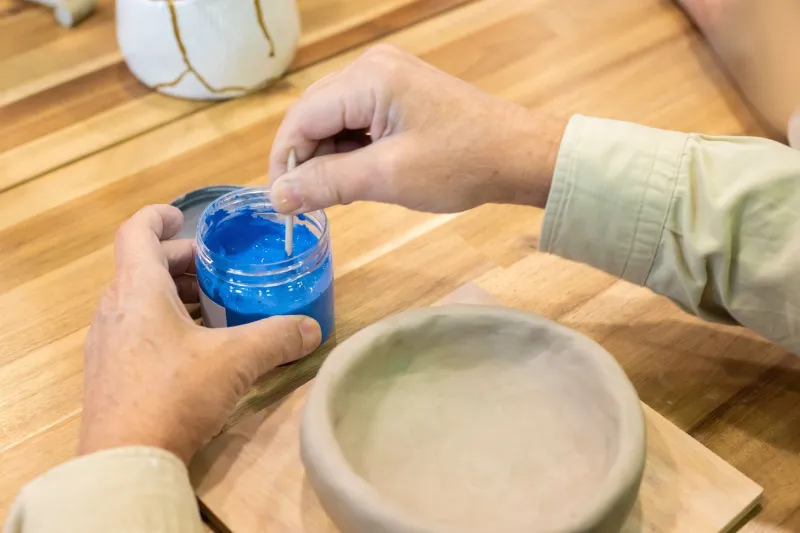
The process itself is painstaking. Urushi lacquer — harvested from the sap of the urushi tree — requires careful layering, precise humidity control, and serious patience. A single repair can take weeks. The gold is applied last, tracing the fracture lines with a delicacy that turns damage into detail. The finished piece doesn't look like nothing happened. It looks like something happened, and the object survived.
Why This Hits Differently in America Right Now
Here's the thing about kintsugi landing in the American consciousness at this particular moment: it makes sense. There's a growing exhaustion with the throwaway cycle. Fast furniture that splinters after two moves. Dishes that chip on the third wash. A constant low-grade guilt about landfills and consumption that most of us don't quite know how to act on.
Kintsugi doesn't ask you to become a minimalist or overhaul your lifestyle. It just asks one quieter question: what if this thing you love is worth keeping?
Sagamihara artisan Yuki Hayashi, who runs a small repair studio and teaches occasional workshops, describes the emotional dimension of the work as something her American students often find surprising. "They come expecting a craft class," she says with a laugh. "And then they bring in a mug their grandmother used, or a bowl from their first apartment, and suddenly it's not just about glue and gold. It's about what they want to hold onto."
That's not accidental. The objects people bring to kintsugi practitioners tend to be the ones they couldn't bear to throw away but didn't know what to do with. A cracked serving dish from a wedding registry. A teapot handed down through a family. These are things that carry weight, and the act of repairing them — slowly, intentionally, with actual gold — is a way of saying they're worth the effort.
The Craft Behind the Philosophy
If you're thinking about trying kintsugi yourself, it helps to understand what you're actually working with. Authentic urushi lacquer is the traditional material, but it requires careful handling — it can cause skin reactions similar to poison ivy in some people, and it needs controlled conditions to cure properly. Many beginner kits sold in the US use synthetic lacquer alternatives, which are more accessible but produce a slightly different result.
Sagamihara's craftspeople tend to be protective of the traditional method, and reasonably so. Matsumoto notes that part of what makes genuine kintsugi meaningful is the commitment the process demands. "When something takes time and skill, you pay attention differently," he says. "You're not just fixing an object. You're deciding it matters."
For those who want the real thing without the learning curve, a number of Sagamihara artisans now offer repair services that ship internationally — you send the broken pieces, they do the work, and what comes back is something transformed. It's a different experience than doing it yourself, but for a truly irreplaceable object, it might be exactly the right call.
What It Changes When You Live With It
Here's what people who've brought kintsugi into their homes consistently report: they start looking at damage differently. Not just in ceramics — in furniture, in clothing, in the general wear-and-tear of a life actually being lived in a space. The philosophy has a way of spreading.
Hayashi describes a student who came back to her studio months after a workshop to say she'd stopped replacing things as quickly. "She said she started asking herself whether something was broken or just changed," Hayashi recalls. "That's a different question."
It's also, quietly, a more sustainable one. Americans generate an enormous amount of waste from household goods — the EPA estimates that furniture and furnishings alone account for tens of millions of tons of landfill material annually. Kintsugi isn't a solution to that at scale, but it's a practice that rewires the individual reflex. It makes repair feel like a legitimate option rather than a consolation prize.
Bringing It Home
You don't need a broken heirloom to start thinking about kintsugi. You just need to notice the things in your home that you've been keeping out of sentiment but haven't quite known what to do with. The chipped bowl shoved to the back of the cabinet. The cracked vase sitting in a closet. These aren't failures waiting to be thrown out. According to the craftspeople of Sagamihara, they might be the most interesting objects you own — they just need someone willing to look at them that way.
The gold doesn't erase the crack. It follows it. And in doing so, it turns what looked like an ending into something that reads, unmistakably, like a continuation.
That's a pretty good thing for a bowl to teach you.